Packaging Design & Guides
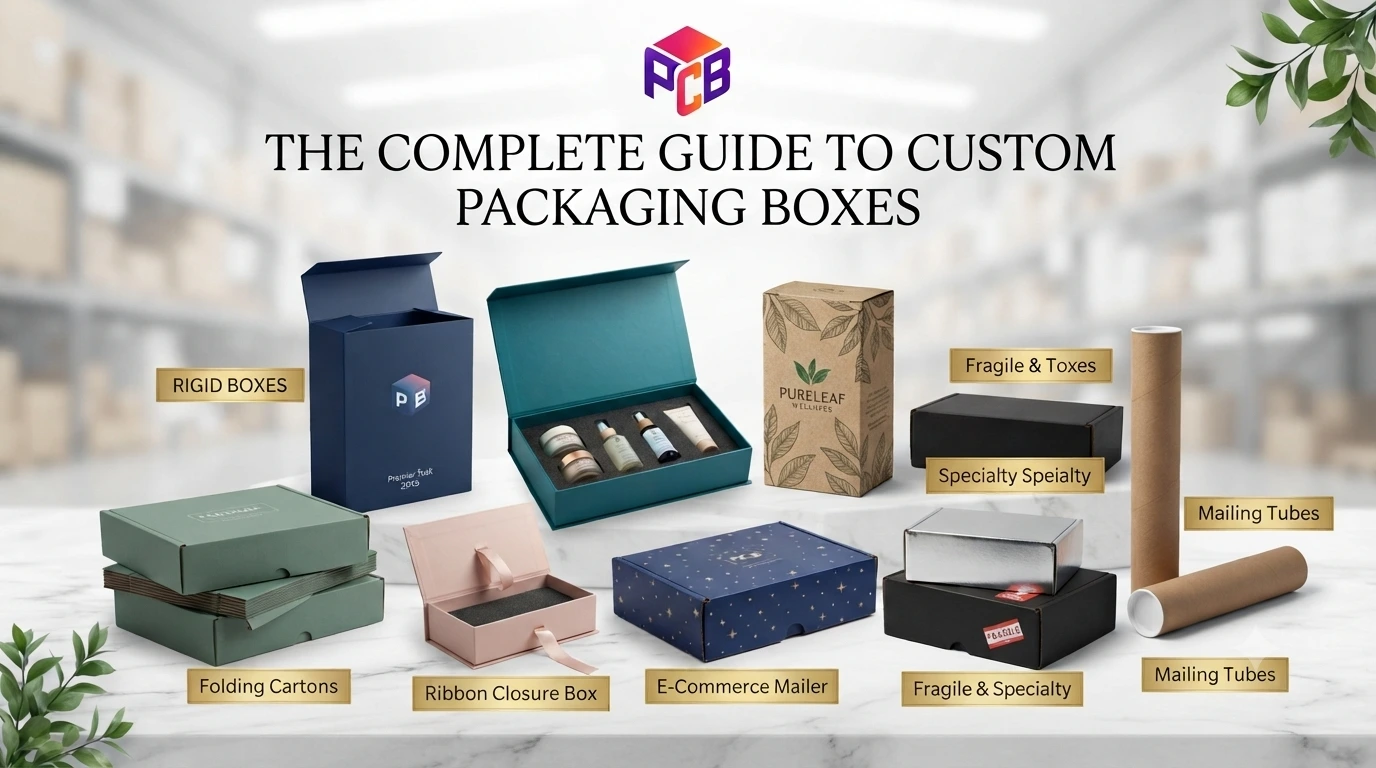
The Complete Guide to Custom Packaging Boxes
📋 Key Takeaways
- Custom boxes are now accessible to small businesses too — MOQs as low as 50 units at some manufacturers.
- The four core materials are cardboard, kraft, corrugated, and rigid board, each suited to a different job.
- Standard production runs 10-12 business days; rush options can bring that down to 7-9 days.
- Small businesses commonly see a 10-20% sales lift after switching from generic to custom packaging.
- Getting a physical sample before a bulk order is the single best way to avoid an expensive mistake.
Quick Answer
Custom packaging boxes are boxes built to your exact size, material, and branding specifications instead of a generic stock size. Pricing depends on quantity, material, and finish; most manufacturers now offer MOQs from 50 units, with production taking roughly 7-12 business days depending on complexity.
If you’ve never ordered custom packaging before, the process can feel more complicated than it needs to be — dozens of material names, printing methods, finish options, and pricing variables that don’t mean much until someone explains what they actually change. This guide is that explanation.
We’ll walk through what a custom box actually is, which material fits which product, how pricing really works, and the exact steps to go from “thinking about it” to a box in your hands — so you can order with confidence instead of guessing.
Quick Jump
What Is a Custom Packaging Box?
A custom packaging box is a box manufactured to your exact specifications — size, material, print, and finish — rather than pulled from a generic stock catalog. That means the box is built around your actual product dimensions, carries your logo and brand colors, and can include structural features like windows, inserts, or a specific closure style.
The broader custom packaging market reflects how mainstream this has become: the U.S. custom packaging boxes segment alone was valued at roughly $50.6 billion in 2026, with boxes representing the largest single product segment in the category, according to Fortune Business Insights. This isn’t a niche upgrade anymore — it’s become close to standard practice for brands that sell direct to consumers.
Custom vs. Stock Packaging: Is It Actually Worth It?
Stock (generic) boxes are pre-manufactured in standard sizes with no branding — cheap, fast, and immediately available. Custom boxes cost more upfront and take longer to produce, but they solve problems stock boxes structurally can’t.
✓ Pros of Custom Boxes
- Fits your product exactly — less wasted space, less shifting damage
- Carries your logo, colors, and finish — real brand recall
- Available from low MOQs (50 units at many suppliers)
- Can include structural features (windows, inserts, locks)
- No die/plate charges or design fees at most manufacturers
✗ Cons of Custom Boxes
- Higher per-unit cost than stock boxes at very low volume
- Longer lead time (7-12+ business days vs. same-day stock pickup)
- Requires a die/mold for the shape — a one-time setup step
- Reordering a different size means a new die investment
| Factor | Stock Boxes | Custom Boxes |
|---|---|---|
| Branding | None | Full logo, color, and finish control |
| Fit | Generic sizes only | Built to your product’s exact dimensions |
| Lead time | Immediate / same-day | Typically 7-12 business days |
| Best for | Internal shipping, unbranded bulk goods | Customer-facing products, DTC brands, retail |
What Materials Are Custom Packaging Boxes Made From?
Four materials cover most use cases, and picking the right one has more impact on cost and performance than almost any other decision in the process.
| Material | Best For | Key Trait |
|---|---|---|
| Kraft paper | Eco-conscious brands, food, wellness | Biodegradable, natural uncoated look, available bleached or unbleached |
| Cardboard (SBS) | Retail products, cosmetics, general branding | Smooth print surface, available 12pt-24pt thickness |
| Corrugated board | Shipping, mailers, heavier products | Single/double/triple wall options, excellent crush resistance |
| Rigid board | Luxury gifting, jewelry, premium cosmetics | Non-bendable, highest-end presentation and finish quality |
💡 WORTH KNOWING
Kraft paper comes in two forms: bleached (available in white and other colors, slightly less durable) and unbleached (natural brown tone, more durable, instantly reads as “eco”). Pick based on whether you want the sustainability signal visible or the material just performing quietly in the background.

What Printing Methods and Finishes Are Available?
Printing method affects both color accuracy and cost. Most manufacturers support:
- Offset printing — best color consistency at high volume
- Digital printing — best for short runs and fast turnaround, no plate cost
- Gravure printing — high-volume, high-detail production
- Screen printing — simple designs, strong opacity on dark materials
Color accuracy typically runs through CMYK (four-color process) or PMS (Pantone matching) systems — PMS is worth requesting specifically if your brand colors need to be pixel-perfect consistent across every order.
Finish options add texture and visual hierarchy on top of the base print:
- Embossing / debossing — raised or pressed tactile detail, including blind (colorless) versions
- Foil stamping — gold, rose gold, silver, black, and holographic options
- Lamination — soft-touch, gloss, or matte surface finish
- Spot UV / raised UV — glossy accent against a matte base
- Custom inserts — foam, EVA foam, dividers, or die-cut trays
- Custom windows — die-cut or PVC windows for product visibility
Related Packaging Categories:
Mid-Article CTA
Want a Free 2D/3D Mockup Before You Commit?
See exactly how your material, print, and finish choices will look before a single box gets produced.
Get a Free QuoteWhat Does a Custom Packaging Box Actually Cost?
Five variables drive most of the price: order quantity, material, box size, printing method, and finish. Quantity has the single biggest effect — setup costs (like die-cutting) are fixed regardless of order size, so spreading them across more units drops the per-unit price fastest. Material follows close behind: kraft and standard cardboard sit at the affordable end, while rigid board and heavy multi-wall corrugated cost more per unit. Finishes are additive on top of the base price — a single accent finish (like foil on a logo) adds far less than full-panel coverage or multiple stacked effects.
The most reliable way to control cost without hurting quality is ordering in a batch size that matches your actual near-term need, choosing one finish rather than several, and getting an itemized quote that separates material, print, finish, and any setup fee — so you know exactly what’s driving the number.
What’s the Minimum Order Quantity for Custom Boxes?
This used to be the biggest barrier for small businesses — many manufacturers required thousands of units before custom packaging was even an option. That’s changed. Several suppliers, including Prime Custom Boxes, now offer custom boxes starting from as few as 50 units, which makes custom packaging realistic for a first product launch or a small seasonal batch, not just an established brand doing a large reorder.
⚠ WORTH AVOIDING
A very low MOQ sometimes comes with a proportionally high per-unit price to offset the fixed setup cost. Always compare the total order cost, not just the advertised per-unit price, when comparing suppliers with different MOQs.

How Long Does It Take to Get Custom Boxes Made?
Standard turnaround commonly runs 10-12 business days from order confirmation to delivery, with rush production options bringing that down to roughly 7-9 business days at many suppliers. Complex finishes — foil stamping, die-cut windows, multi-piece rigid boxes — can add time on top of the base estimate, since they require additional tooling or handling steps.
If you’re working toward a launch date, build in buffer time for sample approval before the bulk run starts; that step alone commonly adds several days but prevents a far more expensive reprint if something’s off.
Step-by-Step: How to Order Custom Packaging Boxes
- Measure your product. Get exact length, width, and height, plus any insert or wrapping allowance — this becomes your box’s internal dimensions.
- Choose your material. Match kraft, cardboard, corrugated, or rigid board to your product’s weight and your brand’s positioning.
- Decide on print and finish. Pick a printing method suited to your order size, then one or two finishes that support your brand rather than compete with each other.
- Request a quote and mockup. A reputable supplier will provide a free 2D or 3D mockup before production so you can review the design digitally first.
- Order a physical sample. Confirm material feel, print color accuracy, and structural fit in person before committing to a bulk run.
- Approve and place the bulk order. Once the sample checks out, confirm quantity and finalize turnaround time.
- Track production and delivery. Confirm lead time expectations upfront, especially if you’re working against a launch date.
Does Custom Packaging Actually Increase Sales?
The data says yes, more often than brands expect. Packaging ROI research shows small businesses commonly see a 10-20% sales lift after upgrading from generic to well-designed custom packaging, driven by higher conversion, more repeat purchases, and fewer damage-related returns eating into margin. The effect tends to be strongest for direct-to-consumer brands, where the box is the customer’s first physical interaction with the product.
That doesn’t mean every dollar spent on packaging pays back equally — a $200-400 first custom order for a small business earning $2,000-5,000/month in revenue is a very different bet than a full luxury rigid-box program for a six-figure brand. The principle holds at both ends: match the packaging investment to where the business actually is today, not where you hope it will be next year.
Mistakes to Avoid When Ordering Custom Packaging
- Skipping the physical sample. Screen colors and printed colors don’t always match — a sample catches this before a bulk run does.
- Oversizing “to be safe.” Extra void space increases material cost and can trigger higher dimensional-weight shipping charges.
- Comparing quotes on per-unit price alone. Setup fees, freight, and rush charges can flip which quote is actually cheaper overall.
- Choosing finish over fit. A beautifully finished box that doesn’t match the product’s actual dimensions still looks and ships worse than a plain box that fits.
Ready to see your own packaging designed and quoted? Get a free quote from Prime Custom Boxes — free 2D/3D mockups, no die or plate charges, and orders starting from just 50 units.
Frequently Asked Questions
Stock boxes are pre-made in standard sizes with no branding, while custom boxes are built to your exact dimensions with your logo, colors, and finish. Custom boxes cost more per unit at low volume but reduce wasted space, damage, and generic-looking packaging.
Minimum order quantities vary by supplier, but many manufacturers, including Prime Custom Boxes, now offer custom boxes starting from as few as 50 units, making custom packaging realistic for small businesses and product launches, not just large brands.
Standard production and shipping typically takes 10-12 business days, with rush options available in 7-9 business days depending on the supplier. Complex finishes like foil stamping or die-cut windows can add time to the production stage.
Data from packaging ROI studies shows small businesses commonly see a 10-20% sales lift after upgrading from generic to well-designed custom packaging, driven by higher conversion rates, repeat purchases, and fewer damage-related returns.
The four most common materials are cardboard (SBS paperboard), kraft paper, corrugated board, and rigid board. Each suits a different combination of product weight, budget, and presentation goals, from lightweight retail cartons to premium unboxing experiences.
Ready to Get Started?
Turn Your Idea Into a Custom Packaging Box
Free design support, free 2D/3D mockups, and free shipping across the USA. No minimum order pressure, no die or plate charges.
Get Your Free Quote Now