


Packaging Design & Guides
How Much Does a Custom Tuck Box Cost in 2026? A Real Pricing Breakdown
📋 Key Takeaways
- Most custom tuck boxes run $0.50-$3.00 per unit in 2026, depending mostly on order volume.
- Order quantity moves the price more than any other factor — going from 500 to 1,000 units can cut cost per unit by 30-50%.
- A one-time die-cutting mold ($150-$300) is usually reusable, so it only really costs you on the first order.
- Digital printing wins below roughly 2,000-3,000 units; offset/flexo wins above that if the design stays fixed.
- Packaging typically runs 8-15% of retail price for everyday goods, and 20-40% for premium products.
Quick Answer
A custom tuck box typically costs $0.50 to $3.00 per unit in 2026. Small orders under 500 units usually sit at $1.50-$3.00+ per unit because setup costs get spread across fewer boxes. Orders of 5,000 units or more can bring a standard printed carton down to $0.50-$0.90 per unit. The rest of this guide breaks down exactly what pushes your quote up or down — and where you can cut cost without cutting quality.
Ask five packaging suppliers “how much does a tuck box cost” and you’ll get five different numbers, usually with no explanation of why. That’s not because anyone’s lying — it’s because a tuck box quote is built from five or six separate variables stacked on top of each other, and most quotes just show you the final number.
This guide breaks the number apart. Every figure below is cross-checked against multiple current industry pricing sources, not a single supplier’s marketing page, so you can use it to sanity-check a quote you’ve already received or budget one before you ask for it.
Quick Jump
- 1. What’s the real per-unit cost?
- 2. What moves the price most?
- 3. How much do finishes add?
- 4. What does the die/tooling cost?
- 5. Which structure costs more?
- 6. Digital vs offset — the real crossover
- 7. What hidden costs get missed?
- 8. How much should packaging cost vs my product?
- 9. How do you lower cost without hurting quality?
- FAQs
1. What Does a Custom Tuck Box Actually Cost Per Unit in 2026?
Here’s a realistic range by order size for a standard printed paperboard tuck box with one basic finish (matte or gloss lamination). These are planning ranges pulled from current industry pricing data, not a quote from any single supplier — your exact number will move within these bands based on size, board grade, and finish.
| Order Quantity | Typical Cost Per Unit | Why |
|---|---|---|
| 250-500 units | $1.75-$3.00+ | Setup costs (die, plate) spread across very few units |
| 1,000-3,000 units | $1.00-$1.75 | Sweet spot for digital printing; setup cost mostly absorbed |
| 5,000-10,000 units | $0.60-$0.95 | Offset/flexo becomes viable; per-unit material cost dominates |
| 10,000+ units | $0.45-$0.70 | Maximum economies of scale; mainly board and ink cost remain |
Kraft board runs slightly higher than plain C1S paperboard per unit (kraft’s natural look costs a bit more to source), while heavier board grades and multi-panel structural add-ons — inserts, windows — push any of these ranges up further. Treat this table as your starting point for a quote conversation, not the final word on what you’ll pay.

2. What’s the Single Biggest Factor That Moves the Price?
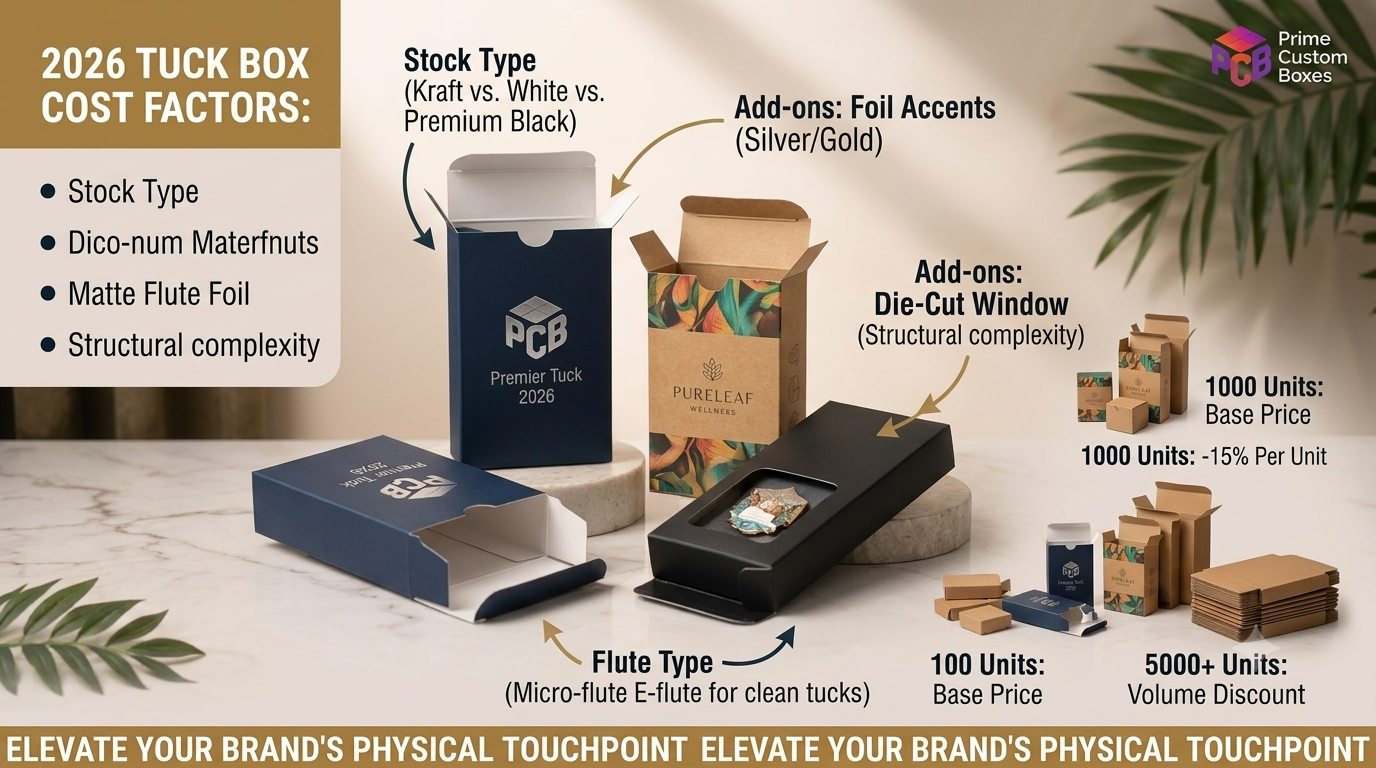
Order quantity, by a wide margin. A tuck box quote carries fixed costs — die-cutting tools, printing plate setup, machine calibration — that don’t change whether you order 300 boxes or 30,000. Spreading that fixed cost across more units is what drops the per-unit price, not some hidden bulk discount.
In practical terms: going from 500 units to 1,000 units can cut your per-unit cost by 30-50% on its own, before you change anything else about the design. That’s usually a bigger lever than switching board grade or dropping a finish.
💡 WORTH KNOWING
If you’re testing a product and unsure about demand, it’s often cheaper overall to order a slightly larger first batch than to reorder a small batch twice — you’d pay the setup cost twice instead of once.
3. How Much Do Finishes Actually Add to the Cost?
Every finish adds cost somewhere — either a small per-unit bump or a one-time tooling fee. Here’s roughly what each one does to a quote:
- Soft-touch / matte lamination — a modest per-unit increase over standard gloss lamination; no tooling cost.
- Foil stamping — needs its own die (often combinable with an embossing die), then a per-unit cost that scales with the foil coverage area. A small logo is affordable; full-panel foil gets expensive fast.
- Embossing / debossing — needs a metal die, minimal per-unit cost afterward, cheapest when paired with a foil die you’re already tooling up for.
- Spot UV — a moderate per-unit cost with no separate die needed in most digital or offset setups.
- Windows or inserts — can add roughly 10-25% to the unit price depending on how much manual handling they require.
Stacking several finishes together compounds quickly — a foil-plus-emboss-plus-window combination can meaningfully change your per-unit number versus a single clean finish. That’s not a reason to avoid finishes; it’s a reason to pick one or two intentionally rather than defaulting to “add everything.”
4. How Much Does the Die (Tooling) Actually Cost?
A standard die-cutting mold — the tool that cuts your box’s exact shape — typically runs $150-$300 as a one-time fee. This is the detail that trips up a lot of first-time buyers comparing quotes: a supplier quoting a lower per-unit price might be excluding the die fee and adding it as a separate line item later.
The upside: that die is usually yours to reuse. If you reorder the same box shape later, you won’t pay the tooling fee again — only material, print, and finish costs apply to the reorder. This is part of why a first order often looks more expensive per unit than a second identical order.
⚠ WORTH AVOIDING
Always ask directly whether the die fee is included in the quoted per-unit price or billed separately. Comparing a “die included” quote against a “die extra” quote as if they’re the same thing is the most common way buyers get an unpleasant surprise on the final invoice.
5. Straight Tuck, Reverse Tuck, or Auto-Lock Bottom — Which Costs More?
Structure affects both unit cost and labor cost, and the two don’t always move in the same direction.
| Style | Unit Cost | Assembly Cost |
|---|---|---|
| Straight tuck end | Lowest — simplest die | Slower to fold by hand |
| Reverse tuck end | Similar to straight tuck | Comparable fold time |
| Auto-lock bottom | Roughly 10% higher than straight tuck | Pops into shape — cuts assembly time by around half |
The auto-lock bottom is a good example of a cost that looks worse in isolation but often nets out cheaper overall — if your team is hand-assembling thousands of boxes, the labor time saved usually outweighs the extra 10% in material cost. Run the total math (unit cost plus labor), not just the per-box quote, before deciding.

Related Packaging Categories:
Mid-Article CTA
Want a Real Number, Not a Range?
Send us your box size, quantity, and finish and we’ll give you an itemized quote — die fee and all — within one business day.
Get a Free Quote6. Digital vs Offset Printing: Where’s the Real Crossover Point?
Digital printing has no plate cost, so it’s typically cheaper below roughly 2,000-3,000 units. Above that range, offset (flexo) usually pulls ahead because its per-unit cost drops faster once the plate cost is amortized across a bigger run — provided your design doesn’t change between print runs, since every design change on offset means a new plate.
The exact crossover shifts with box size and color count, so treat “2,000-3,000 units” as a planning range, not a hard line — get quotes both ways at your real quantity if you’re near that threshold.
7. What Hidden Costs Do Buyers Usually Miss?
A quote’s headline per-unit number rarely tells the whole story. Line items that commonly get added separately, or missed entirely in a first estimate:
- Die-cutting tooling — covered above; ask if it’s included.
- Sample or prototype fees — a physical sample before a full run often costs several times the per-unit production price, since it’s a one-off.
- Freight and shipping — some suppliers quote factory-direct pricing (EXW) and bill freight separately; others bundle it in.
- Rush production fees — expedited turnaround commonly adds a noticeable premium over standard lead time.
The only fair way to compare two quotes is total landed cost — everything included, delivered to your door — not just the per-unit factory price.
8. How Much Should Packaging Actually Cost Relative to My Product?
This depends heavily on where your product sits in the market. For everyday, price-competitive retail goods, packaging typically runs 8-15% of the retail price. For premium or luxury products, packaging can reasonably run 20-40% of total product cost, because the packaging itself is doing real work adding perceived value — a $20 product might carry $1-$3 of packaging, while a $100 premium product can justify $8-$20.
If your packaging cost is creeping meaningfully above these bands without a clear premium-positioning reason, that’s usually a sign to revisit board grade or finish choices rather than order quantity.
9. How Do You Lower Tuck Box Cost Without Hurting Quality?
- Order closer to a volume break. If you’re at 400 units, check what 500 or 1,000 costs — the jump in savings often outweighs the extra units you didn’t strictly need.
- Right-size the dimensions. Optimizing box size for better sheet nesting (how many boxes fit per printing sheet) can lower unit price by 10-20% on its own.
- Pick one finish, not four. A single well-executed finish gets most of the “premium” perception for a fraction of a full-coverage, multi-finish cost.
- Ask if your die fee carries forward. If you plan to reorder the same shape, confirm the die is yours to reuse before you pay for it again unnecessarily.
- Compare total landed cost, not headline price. A slightly higher per-unit quote that includes freight and tooling can beat a lower quote that adds both back later.
💡 WORTH KNOWING
The fastest, lowest-risk way to lower your real cost is usually the box dimensions, not the material or finish. A box that’s even slightly oversized wastes board on every single unit you order — that waste compounds across your whole run in a way a finish choice doesn’t.
Want your current spec reviewed? Request a free sample and quote from Prime Custom Boxes — we’ll give you an itemized breakdown so you know exactly what you’re paying for, with no minimum order required.
Frequently Asked Questions
Most custom tuck boxes cost between $0.50 and $3.00 per unit in 2026, depending on order volume, board grade, and finish. Small orders under 500 units often land at the higher end or above it, while orders of 5,000+ units can bring the per-unit price down toward $0.50-$0.90 for a standard printed carton.
Order quantity. Setup costs like die-cutting tools and printing plates are fixed regardless of order size, so spreading them across more units drops the per-unit price fastest. Moving from 500 to 1,000 units can cut the per-unit cost by 30-50% on its own.
A standard die-cutting mold typically costs $150-$300 as a one-time fee. It’s usually reusable for future reorders of the same box shape, so it only adds real cost to your first order, not repeat ones.
Digital printing is typically cheaper below roughly 2,000-3,000 units because it has no plate setup cost. Offset (flexo) becomes more cost-effective above that range since its per-unit cost drops faster once the plate cost is spread across a larger run.
For everyday retail products, packaging typically runs 8-15% of the retail price. For premium or luxury products, it can reasonably run 20-40% of the total product cost because packaging itself adds to the perceived value.
Ready for a Real Number?
Get an Itemized Quote — No Guessing, No Hidden Fees
Free design support, free 2D/3D mockups, and free shipping across the USA. No minimum order, no die or plate charges hidden later.
Get Your Free Quote Now


