


CBD Packaging
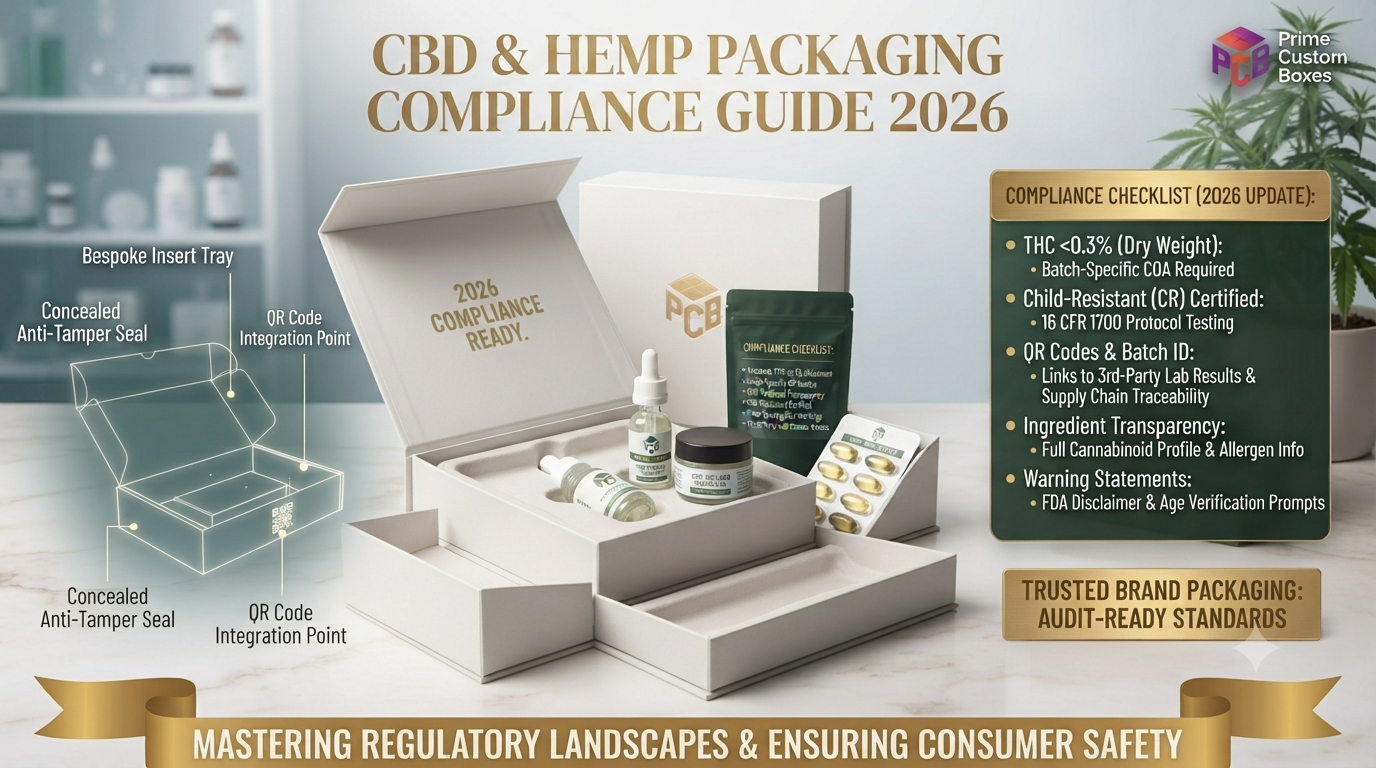
CBD & Hemp Packaging Compliance Guide 2026
📋 Key Takeaways
- A new federal cap limits finished hemp products to 0.4mg total THC per container — separate from the older 0.3% dry-weight plant rule.
- The FDA still bans disease and health claims on CBD packaging, regardless of state legality.
- Child-resistant packaging is increasingly required at the state level, and must meet CPSC 16 CFR 1700 standards where mandated.
- No single federal law requires a QR code, but several states now mandate one linking to a batch-specific Certificate of Analysis.
- Material choice alone doesn’t create compliance — labeling accuracy, font size, and structure all matter together.
Quick Answer
CBD and hemp packaging compliance in 2026 rests on five things: staying under the new 0.4mg total THC per container cap, keeping all label claims free of disease or therapeutic language, including accurate cannabinoid and batch information, meeting child-resistant packaging standards where your state requires them, and providing QR-linked lab results where mandated. Getting the structure and finish right matters for branding — but none of it matters if the label itself isn’t compliant first.
CBD and hemp packaging carries a burden most other product categories don’t: it has to look like a consumer brand and read like a compliance document at the same time. Ingredients, dosage, warnings, batch codes, and QR links all need a place on the box, and getting any of them wrong doesn’t just look sloppy — it can trigger an FDA warning letter, a state enforcement action, or a Prop 65 lawsuit.
2026 makes this more complicated, not less. A new federal rule has changed how much THC a finished product can legally contain per container, and it’s easy to still be designing packaging around the old rule. This guide walks through what actually changed, what’s still required federally and by state, and how to build packaging that’s compliant first and good-looking second — because in this category, that order matters.
Quick Jump
- 1. What changed for 2026?
- 2. 0.3% vs 0.4mg — what’s the difference?
- 3. What must the FDA label include?
- 4. Does your box need to be child-resistant?
- 5. Do you need a QR code?
- 6. Which states add extra rules?
- 7. What materials support compliance?
- 8. What mistakes cause the most problems?
- Compliance checklist
- FAQs
1. What Actually Changed in CBD/Hemp Regulation for 2026?
The single biggest shift is a new federal ceiling on THC in finished consumer products. Under the 2026 Continuing Appropriations Act, the definition of legal hemp was narrowed to exclude any final product containing more than 0.4 milligrams per container of combined tetrahydrocannabinols and cannabinoids that produce, or are marketed to produce, similar effects. This applies at the container level, not as a percentage — a distinction that catches a lot of brands off guard.
This is a meaningfully different rule from what most packaging still references. If your labels were designed around the 2018 Farm Bill’s plant-level definition alone, they may already be out of step with how finished products are now regulated.
2. The 0.3% Rule vs. the 0.4mg Cap: What’s the Difference?
These are two separate rules that apply at two separate stages, and confusing them is one of the most common compliance mistakes in the industry right now.
| Rule | What It Measures | What It Applies To |
|---|---|---|
| 0.3% dry weight (2018 Farm Bill) | Delta-9 THC concentration in the raw plant | Whether the crop itself legally counts as “hemp” |
| 0.4mg per container (2026 Appropriations Act) | Total THC and THC-like cannabinoids in the finished product | Whether the finished retail product is legal to sell |
A product can be sourced from fully compliant, low-THC hemp under the plant-level rule and still fail the new container-level cap if the finished formulation concentrates cannabinoids during extraction. Packaging copy that only references “0.3% THC” without addressing the per-container limit is now presenting an incomplete compliance picture.

3. What Must a CBD Label Actually Include Under FDA Rules?
Federally, the FDA still treats CBD as excluded from the dietary supplement definition and prohibited as a food additive, which means labeling has to be handled carefully regardless of state legality. At minimum, compliant labels typically include:
- An identity statement describing what the product is and its intended use
- A complete list of ingredients, including hemp and CBD content clearly identified
- The manufacturer, packer, or distributor’s name and address
- Net quantity and CBD amount per serving, with servings per container for multi-serving products
- A disclaimer on any wellness-adjacent statement noting the FDA has not evaluated it
What can’t appear: any claim that the product treats, cures, or prevents a disease or medical condition. The FDA continues to issue warning letters over this specific issue more than almost any other, and even implied claims — not just explicit ones — can trigger action.
💡 WORTH KNOWING
“THC-free” should only appear on a label when lab results confirm non-detectable levels under the applicable testing standard. Using it as a marketing shortcut without lab backing is a common and easily avoidable compliance gap.
Related Packaging Categories:
Mid-Article CTA
Need Packaging That’s Compliant First?
We’ll help you fit every required label element at a readable size without sacrificing your brand design.
Get a Free Quote4. Does Your CBD Packaging Need to Be Child-Resistant?
Increasingly, yes, especially for edibles and higher-potency products, though the requirement varies by state rather than applying uniformly nationwide. Where child-resistant packaging is required, it must meet the CPSC’s federal standard under 16 CFR 1700, which sets a specific bar: at least 85% of tested children must fail to open the package within the first 5 minutes, and at least 80% must still fail after 10 minutes, while at least 90% of adults must be able to open it within 5 minutes.
This isn’t a design suggestion — it’s a tested, certified standard. Packaging marketed as “child-resistant” without third-party testing to this protocol is a compliance risk, not a compliance solution.
5. Do You Need a QR Code on Your Packaging?
There’s no blanket federal QR code mandate, but the state-level picture has shifted quickly. Several states now require a scannable QR code or printed web address that links directly to a batch-specific Certificate of Analysis (COA) — verified third-party lab results confirming cannabinoid content and screening for contaminants. New York is among the states that mandate this for hemp products sold within the state.
Even in states without a legal requirement, linking a QR code to real batch-matched lab results has become close to standard practice, since it directly addresses one of the industry’s biggest trust problems: inaccurate potency labeling. Independent reporting has repeatedly found a large share of CBD products mislabeled on actual cannabinoid content, which is exactly what a verifiable QR-linked COA is designed to prevent.
⚠ WORTH AVOIDING
A QR code that doesn’t match the batch or lot number printed on the package defeats the purpose and can itself be treated as a labeling violation. The COA linked must correspond to the exact batch inside that specific box.
6. Which States Add Requirements Beyond Federal Law?
Because CBD sits in a patchwork of state and federal rules, the safest approach for any brand shipping to multiple states is designing packaging around the strictest applicable requirement, not the federal minimum. A few examples worth knowing:
- California requires Prop 65 warning language on any product containing detectable THC, even trace amounts, since THC is a listed compound with no exempted minimum threshold.
- New York mandates QR codes linking to lab results on hemp products sold in-state.
- Indiana requires expiration dating not more than two years from the manufacture date.
- Multiple states require font size minimums for compliance text — commonly no smaller than 6pt on primary panels, with warning statements requiring roughly 1/16 inch letter height.
If you sell nationally, this patchwork is exactly why “compliant in one state” isn’t the same as “compliant everywhere” — a national brand’s packaging effectively has to satisfy the sum of every state’s individual requirements at once.

7. What Materials and Structures Actually Support Compliance?
No material makes a product legally compliant on its own — that’s a labeling and formulation question. But material and structure choices directly affect whether you can physically fit required text at a readable size without wrecking the design.
- Kraft paperboard — widely used for gummies and capsule cartons; enough surface area for full compliance text, and reads as natural/eco-conscious, which aligns well with the wellness positioning most CBD brands want.
- Rigid boxes — suited to higher-potency tinctures and gift sets where a premium presentation matters and there’s still room for full labeling on an inner or outer panel.
- Matte laminate cartons — a professional finish that leaves ample flat space for dense compliance text without visual clutter.
- Custom inserts — useful for separating branding, product information, and legal text into distinct zones so each stays legible instead of competing for the same panel.
8. What Mistakes Cause the Most Compliance Problems?
- Designing around the old 0.3% rule only. That rule governs the plant, not the finished product — the 0.4mg per-container cap is the one that determines whether your retail item is legal to sell.
- Implied health claims. Words like “relief,” “calming,” or “supports recovery” can read as therapeutic claims even without naming a specific condition, and the FDA treats implied claims seriously.
- QR codes that don’t match the batch. A generic or outdated link undermines the entire point of the code and can itself become a labeling issue.
- Undersized compliance text. Squeezing required warnings below the minimum readable size to preserve design space is a frequent, avoidable violation.
- Treating child-resistant packaging as optional everywhere. It’s state-dependent — check the specific states you ship to rather than assuming one national standard applies.
2026 Compliance Checklist
- Confirm total THC per container is under 0.4mg, not just that the source plant tested under 0.3% dry weight.
- Remove any disease, cure, or therapeutic language, explicit or implied.
- Include identity statement, full ingredient list, manufacturer address, and net quantity/serving size.
- Check whether your product category and selling states require child-resistant packaging, and test to CPSC 16 CFR 1700 if so.
- Add a QR code linked to a batch-matched Certificate of Analysis, especially if selling into states that require it.
- Verify compliance text meets minimum font size and contrast requirements on every panel.
- Cross-check labeling against the strictest state you sell into, not just your home state.
Need packaging that’s built around this checklist from the start? Contact Prime Custom Boxes for a free compliance-ready quote — we’ll help you fit every required element without turning your box into a wall of text.
Frequently Asked Questions
Under the 2026 Continuing Appropriations Act, finished hemp-derived consumer products are capped at 0.4 milligrams of total THC and THC-like cannabinoids per container. This is separate from the older 2018 Farm Bill rule, which defines legal hemp as the raw plant containing no more than 0.3% delta-9 THC by dry weight.
It depends on the product and the state you’re selling in, but many states now require child-resistant packaging for CBD and hemp products, especially edibles. Federally, child-resistant packaging must meet CPSC standards under 16 CFR 1700, which require that at least 85% of tested children cannot open the package within 5 minutes.
There’s no single federal mandate requiring a QR code, but several states now require a scannable QR code or web link that leads directly to a batch-specific Certificate of Analysis. Even where not legally required, a QR code linked to third-party lab results is considered a strong compliance and trust-building practice.
No. The FDA prohibits disease or therapeutic claims on CBD packaging, such as claims that a product treats anxiety, pain, or any medical condition. The FDA continues to issue warning letters to brands that make these claims, regardless of whether the underlying product is otherwise legal.
Material doesn’t determine legal compliance on its own, but kraft paperboard and matte laminate cartons are widely used because they provide enough surface area for required label text at readable font sizes, while rigid boxes suit higher-potency tinctures and gift sets where a more premium presentation is expected.
Ready to Ship Compliant Packaging?
Build a Box That’s Audit-Ready, Not Just Attractive
Free design support, free 2D/3D mockups, and free shipping across the USA. No minimum order, no die or plate charges.
Get Your Free Quote Now


