

Packaging Design & Guides
How many cigarettes in a pack? In the United States, a standard pack holds 20 cigarettes. That’s also the legal minimum, so no store can sell a smaller pack. A carton holds 10 packs, which comes to 200 cigarettes.
That’s the quick answer. But if you run a tobacco brand, a smoke shop, or you’re ordering custom packaging, the number is only the start. Stick length changes the pack size. The pack size changes the carton. And the law decides what has to be printed on every panel.
We print tobacco packaging for US brands, so this guide is written from the box side of things. You’ll get the counts, the federal rules, real stick and pack dimensions, and what a compliant pack needs before it goes to print.
Quick answer: 1 pack = 20 cigarettes. 1 carton = 10 packs = 200 cigarettes. A “sleeve” is another word for a carton. Packs with fewer than 20 cigarettes, like the old 10-count “half pack,” can’t legally be sold in the US.
How Many Cigarettes Are in a Pack in the US?
Every legal cigarette pack sold in the US contains at least 20 cigarettes. This isn’t a brand habit. It’s a federal rule.
The FDA’s regulation at 21 CFR 1140.16 bars manufacturers, distributors, and retailers from selling a cigarette package that holds fewer than 20 cigarettes. The rule covers every state, so a pack in Texas holds the same count as a pack in New York.
The goal was to kill off cheap “kiddie packs.” Smaller packs cost less, and a lower price makes it easier for young people to start. Setting a floor of 20 keeps the entry price higher.
Can a pack hold more than 20? Yes. The rule sets a minimum, not a maximum. A few brands have sold 25-count packs over the years. Still, almost every pack you’ll see on a US shelf holds 20.
Packs, Cartons, and Sleeves: The Counting Chart
Retailers and distributors talk in packs and cartons, not single cigarettes. Once you know how many cigarettes in a pack, the rest is simple multiplication. Here’s how the units stack up.
| Unit | Holds | Total cigarettes |
|---|---|---|
| Pack | 20 cigarettes | 20 |
| Carton (also called a sleeve) | 10 packs | 200 |
| Half pack | 10 cigarettes | Not legal for sale in the US |
| Master case | Varies by manufacturer | Ask your distributor |
Two terms confuse people the most. First, “sleeve” and “carton” mean the same thing in everyday US use: the long box of 10 packs. Second, a “pack a day” means 20 cigarettes a day, so one carton lasts a pack-a-day smoker about 10 days.
Master case counts, the big corrugated shipper that holds many cartons, aren’t standardized. They depend on the manufacturer and the stick length. If you’re planning a pallet or a warehouse shelf, get the case spec from your supplier rather than guessing.
Why Are There 20 Cigarettes in a Pack?
Three things lock the US market at 20.
- The federal minimum. As covered above, nothing smaller can be sold, and going bigger raises the shelf price.
- Taxes are built around it. The federal excise tax works out to about $1.01 for a pack of 20. States add their own stamps on top, and those are set per pack too. A standard count keeps that math simple for everyone in the chain.
- The 7-6-7 layout. Twenty round sticks pack neatly into three rows of 7, 6, and 7. The middle row nests between the outer two, so the bundle stays tight, doesn’t rattle, and fits a pocket-sized box.
That last point matters more than people expect. The 7-6-7 bundle is the reason a standard pack is the shape it is. Change the count, and the whole box has to change with it. That’s a big part of why the answer to how many cigarettes in a pack hasn’t moved in decades.
Cigarette Pack Size: How Stick Length Changes the Box
Ask how many cigarettes in a pack and the answer is always 20, but the box isn’t always the same. Stick length decides how tall the pack is. Stick diameter decides how wide and deep it is.
| Stick type | Typical length | Typical diameter |
|---|---|---|
| Regular (short) | About 70 mm (2.75 in) | 7.5–8.0 mm |
| King size | About 84 mm (3.3 in) | 7.5–8.0 mm |
| 100s | About 100 mm (3.9 in) | 7.5–8.0 mm |
| 120s | About 120 mm (4.7 in) | 7.5–8.0 mm |
| Slims (any length) | Varies | About 5–6 mm |
A common mix-up: 100s aren’t automatically slim. “100s” describes length. “Slim” describes width. Most 100s use a standard diameter, which is why a 100s pack is taller than a king-size pack but about the same width. You’ll see some guides list 100s at 5–6 mm. That number belongs to slims.
So what does that mean for the pack itself? A king-size flip-top pack usually measures roughly 3.4–3.5 in tall, 2.2 in wide, and 0.9 in deep. A 100s pack keeps about the same width and depth but grows taller, to roughly 4 in. Slim packs get narrower and thinner.
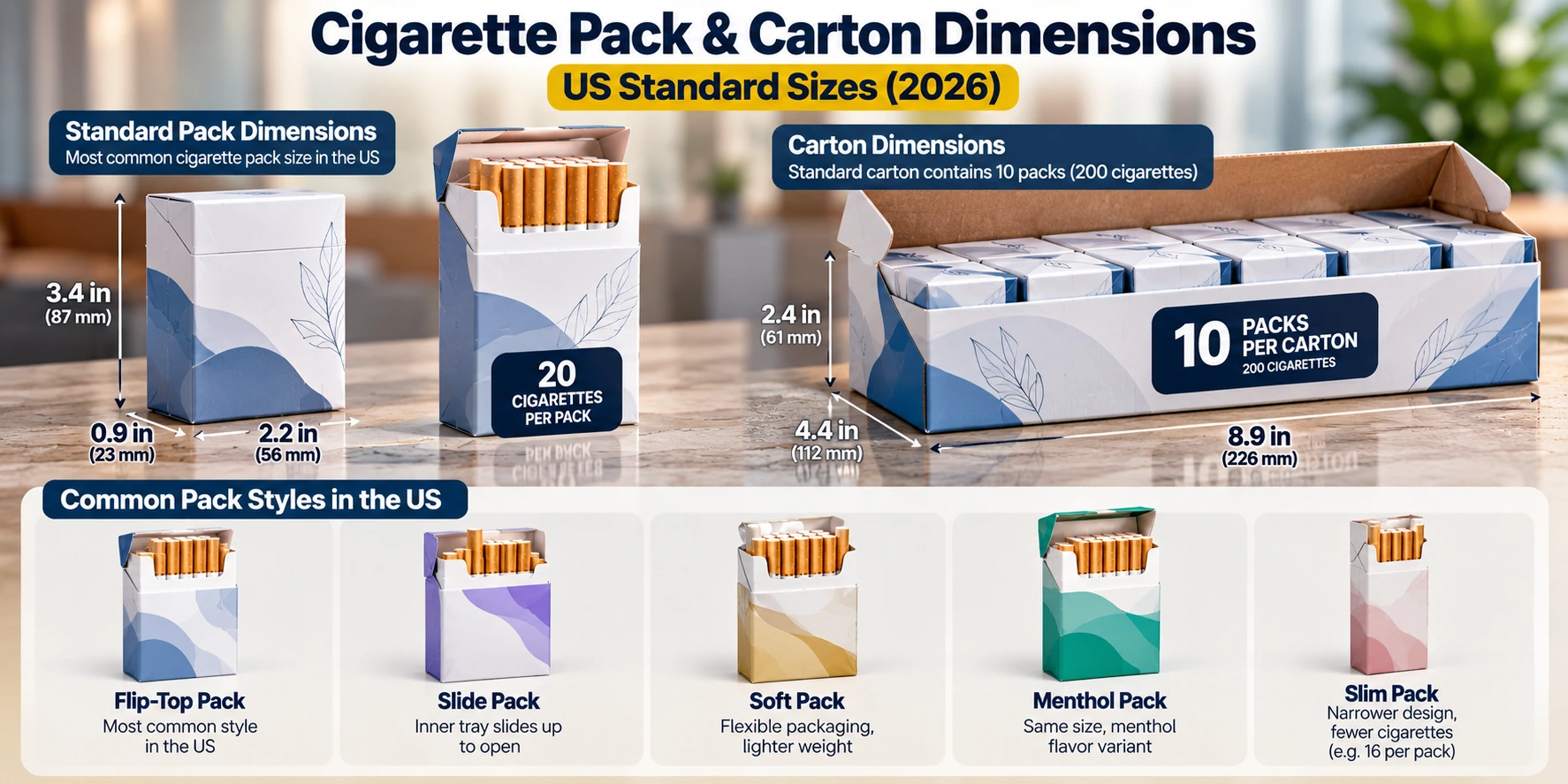
Treat those as ballpark figures, not a spec. Sticks vary by brand, foil and inner frames take up space, and a pack that’s 1 mm too tight crushes filters. The safest way to size a box is to measure your own 20-stick bundle, add clearance for the liner, and check it on a real dieline.
What’s Inside a Standard US Cigarette Pack?
A hard pack looks like one box, but it’s built from several parts. Knowing them helps when you brief a printer, because each part has its own material and job.
Parts of a flip-top pack
- Hinged lid that flips back
- Inner frame (collar) that holds the lid shut
- Foil or paper liner around the 7-6-7 bundle
- Clear overwrap with a tear strip
- Tax stamp area, usually on the bottom
Simplified flip-top pack, front three-quarter view
The outer shell is usually printed paperboard. The liner keeps the tobacco fresh. The inner frame, a separate folded piece glued inside the shell, gives the lid something to close against. And the clear overwrap seals the whole thing until the tear strip is pulled.
Types of Cigarette Pack Styles
Every style below still holds 20 cigarettes in the US. What changes is the structure, the feel, and the cost.
Hard flip-top pack
Most common in the USRigid paperboard shell with a hinged lid and inner frame. It protects the sticks in a pocket and closes cleanly after each use, which is why it dominates US shelves.
Soft pack
Lighter, lower costA paper wrap around the foil bundle, opened by tearing a corner of the top. It uses less board and costs less to make, but it can’t be closed again and crushes more easily.
Slide (drawer) pack
Premium feelAn inner tray slides out of an outer sleeve. It takes more board and more steps to assemble, so brands use it for special editions and premium lines.
Rigid or shoulder-neck box
Gift and limited runsThick chipboard with a lid that sits on a raised “shoulder.” It feels like a gift box. In the US it still has to hold at least 20 cigarettes if it’s sold as a cigarette package.
What Has to Go on a US Cigarette Pack?
How many cigarettes in a pack is only one rule. Before you send artwork to print, make sure the layout leaves room for everything the law and your distributors expect. Here’s a checklist we walk tobacco clients through.

- Surgeon General’s warning. Current US packs carry one of the rotating text warnings required under federal labeling law. Your brand must follow its rotation plan, so plan the warning panel before you design anything else.
- Graphic warnings: watch this space. The FDA issued a rule requiring 11 graphic health warnings that cover a large share of the front and back panels. As of 2026, that rule is still tied up in federal court. Check the FDA’s cigarette labeling page for the current status before you lock a design.
- State tax stamp space. Most states require a tax stamp on every pack, usually applied to the bottom. Keep that panel clear of artwork that the stamp would cover.
- Barcode. Retailers scan packs and cartons separately, so each usually needs its own UPC.
- Product authorization. New cigarette products generally need FDA marketing authorization before they’re sold. A new box design doesn’t change that, so talk to your regulatory advisor early.
- Shipping limits. Federal law bans mailing cigarettes to consumers through the US Postal Service, and online sales face strict rules. That affects how you package and ship cartons.
We’re a packaging printer, not a law firm. Rules change, and the brand owner is responsible for compliance. Use this list as a starting point and confirm the details with your regulatory counsel.
How Much Does a Pack of Cigarettes Cost?
There’s no single US price, and any “average” you see online goes stale fast. The biggest reason is tax. The federal excise tax is about $1.01 per pack of 20, and each state adds its own tax on top. Some cities and counties add more.
That’s why the same brand can cost several dollars more in one state than in the next. If you’re pricing a product, check your state’s current tobacco tax rate rather than a national average.
The count is fixed at 20. The box around those 20 sticks is where a brand actually gets to stand out.
Designing Custom Tobacco Packaging
Once the legal panels are mapped out, the rest of the pack is yours: the color, the finish, the way the lid feels when it opens. With plain text warnings taking up space and possible graphic warnings ahead, smart brands treat every remaining square inch as valuable.
Here’s what usually makes the difference on a tobacco pack:
- A tight, accurate size. Built around your real 20-stick bundle, with the liner and frame accounted for.
- A finish that reads premium in the hand. Matte lamination, soft touch, spot UV on the logo, or foil stamping on the lid.
- Matching cartons. The carton is what distributors and store staff see first, so design it as part of the same family.
- A test run before a big order. Check the fit, the lid action, and the stamp area on real boxes.
You can browse our custom tobacco packaging boxes for styles and finishes. Every order comes with no minimum order, so a small test batch is practical, and there are no die or plate charges.
See your pack in 2D and 3D first
Our free box dieline generator with live 2D/3D mockup lets you enter your pack dimensions, see the flat dieline instantly, and rotate a 3D preview. It’s the fastest way to see whether the warning panel, stamp area, and logo all fit before anything is printed.
When you’re ready to set up artwork, follow our artwork guidelines for print-ready box files: 0.125 in (3 mm) bleed, a 0.25 in (6 mm) safe zone, CMYK color, and 300 DPI images. If you’re new to box design, our step-by-step guide on how to design a custom box walks through each panel.
Selling at the register too? Counter display boxes for retail checkout keep packs organized and visible next to the till.
How Many Cigarettes in a Pack: FAQs
How many cigarettes are in a pack?
A standard US pack holds 20 cigarettes. Federal rules don’t allow packs with fewer than 20, so 20 is both the standard and the minimum.
How many packs are in a carton of cigarettes?
A carton holds 10 packs. With 20 cigarettes in each pack, that’s 200 cigarettes per carton.
How many cigarettes are in a sleeve?
200. In the US, “sleeve” is another name for a carton: 10 packs of 20 cigarettes.
How many cigarettes are in a pack of 100s?
20. “100s” describes the length of each cigarette, about 100 mm, not the count. The pack is taller than a king-size pack but holds the same 20 sticks.
Can you buy a pack of 10 cigarettes in the US?
No. Packs with fewer than 20 cigarettes, including the old 10-count “half pack,” can’t legally be sold in the United States.
Are there packs with more than 20 cigarettes?
Yes, but they’re rare in the US. The law sets a 20-cigarette minimum, not a maximum, and a few brands have sold 25-count packs. Nearly every pack on US shelves holds 20.
How long does a carton last?
About 10 days for someone who smokes a pack a day. A carton holds 10 packs of 20.
What size is a standard cigarette pack?
A king-size flip-top pack is roughly 3.4–3.5 in tall, 2.2 in wide, and 0.9 in deep. Sizes vary by stick length, diameter, and brand, so measure your own bundle before ordering custom boxes.
Get Your Custom Tobacco Packaging Quote
Now you know how many cigarettes in a pack, how cartons count up, and what a US pack needs to carry. The next step is a box built around your exact size. Prime Custom Boxes prints custom packaging for US brands from East Elmhurst, New York, with no minimum order, free design support, a free 2D/3D mockup, no die or plate charges, and free USA shipping on orders over $100.
- No minimum order
- Free 3D mockup
- Standard 10–12 business days
- Rush 7–9 working days
Thinking about quitting? Free help is available at 1-800-QUIT-NOW.